
CO₂ accounting 2024: our emissions in the second reporting year
Following our first CO₂ inventory for 2023, we also fully recorded and evaluated our emissions for 2024. Our ambition remains unchanged: to create transparency, enable well founded decisions, and continue to develop our contribution to emission reduction in a systematic way.
The 2024 results at a glance
In 2024, our total emissions amount to 28.07 tonnes of CO₂.
As in the previous year, the picture is clear: the majority of our emissions do not arise directly in the office, but through the way we work and along our value creation.
The distribution across the scopes for 2024 is as follows:
Scope 1: 2.23 tCO₂
Scope 2: 0.57 tCO₂
Scope 3: 25.27 tCO₂
This once again makes one thing clear: for us as a consulting company, indirect emissions in Scope 3 are particularly relevant. At around 90 percent, they account for by far the largest share of our footprint.
Where most emissions arise
This becomes especially clear when looking at the individual emission sources.
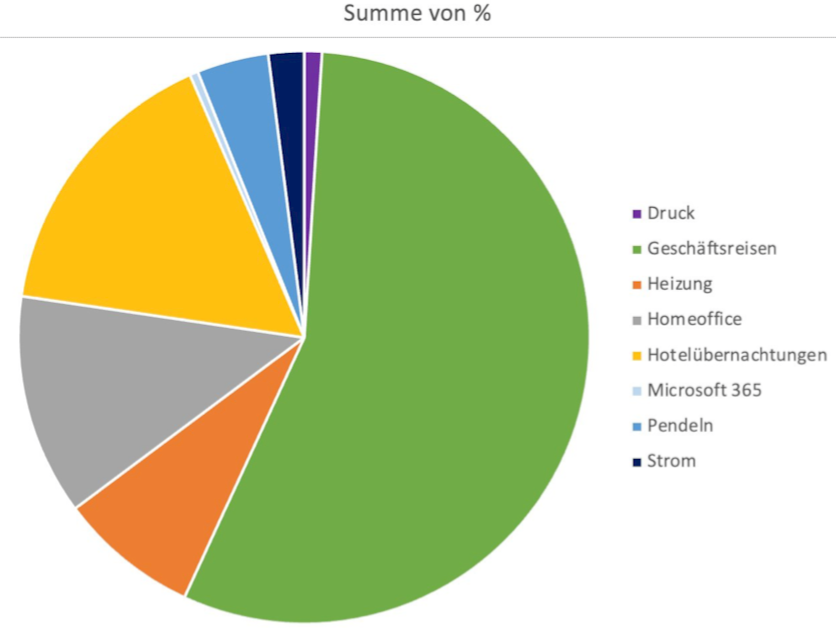
As in 2023, business travel accounts for the largest share of our CO₂ footprint in 2024. At 15.68 tCO₂, it represents 56 percent of our total emissions and therefore remains by far the most significant lever in our inventory.
This is followed by hotel stays at 4.53 tCO₂ and working from home at 3.51 tCO₂. Employee commuting also contributes 1.14 tCO₂ to the total footprint.
By contrast, emissions from heating, electricity, printing, or Microsoft 365 are comparatively low.
This distribution shows clearly that our emissions arise primarily where our work is linked to mobility, on site project work, and decentralized ways of working.
Business travel remains the most important lever
As already shown in our first inventory, business travel remains our most relevant source of emissions in 2024.
This is not surprising. As a consulting company, we work closely with our clients and are present on site in many projects. Completely avoiding travel is therefore not our goal. At the same time, the key question remains how to make necessary mobility as sustainable as possible.
Our existing measures therefore continue to apply:
We do not take domestic flights.
We avoid intercontinental flights.
Whenever possible, rail is our preferred mode of transport.
For us, this remains the decisive area of action if we want to reduce our emissions effectively.
Development compared with the previous year
The comparison with 2023 gives us reason for optimism. In the first reporting year, our emissions stood at 34.86 tCO₂. In 2024, they amount to 28.07 tCO₂. This corresponds to a reduction of 19.5 percent.
This means that we clearly exceeded our goal of reducing emissions by 10 percent per year.
We see this as a positive signal. It shows that the decisions we have made are having an effect and that more conscious planning and a more reflective approach to travel are indeed visible in the data.
At the same time, we interpret this realistically. Not every change automatically represents a lasting trend. Some differences also result from the specific project situation in a given year.
This makes it all the more important for us to build on this progress and continue the development in the years ahead.
Transparency as part of our understanding of responsibility
We publish our results deliberately because we see transparency as the foundation for learning and further development. It enables exchange, makes decisions understandable, and helps ensure that sustainability is not treated as an abstract idea, but as something concrete and verifiable.
If you have ideas for our approach or would like to exchange views with us, we would be pleased to hear from you at: nachhaltigkeit@returnonmeaning.com